

A Houston startup seeking approval for ¶¶Òõh's second-ever carbon capture and storage well has met opposition from Ascension Parish residents, the latest sign of concern over an emerging industry that state leaders view as key for future economic development.
Five-year-old firm Blue Sky Infrastructure is planning an underground carbon dioxide storage hub in the heart of ¶¶Òõh's Mississippi River industrial zone near Geismar and Donaldsonville. The company is currently seeking a permit for the first of seven planned wells, with the initial one to be located in western Ascension Parish.

The project is among more than 30 similar proposals that the state has been examining for potential approval, but backlash from residents and politicians has complicated the plans. Gov. Jeff Landry issued a moratorium on new injection applications last fall to provide time to review the process, but the Ascension proposal is one of six that remained on the state’s fast track.
Effective carbon capture would in theory address two problems at once. ¶¶Òõh's petrochemical industry could lower its carbon footprint and make its products more competitive for foreign export, while climate-warming emissions could be reduced.
But opposition has emerged over land rights, lucrative tax credits helping fund the projects and the potential for C02 leaks, among other concerns. Environmental groups also oppose carbon capture, calling it unproven and a way for industry to avoid phasing out fossil fuels.
Industry backers say the concerns are vastly overblown, the technology has long been used for other purposes and the storage wells will be located thousands of feet underground, capped by a thick layer of impermeable rock.
Those sharply divergent views were on display during a hearing Thursday night before state Department of Conservation and Energy officials in Donaldsonville. Residents in a crowd of more than 60 people at the parish courthouse argued the new well would foster unwanted land grabs for pipelines and other infrastructure.
“Tonight, I stand before you strongly urging you to deny this permit, not out of fear but out of fierce defense of our rights, our wallets and our children’s inheritance," said Donald Bailey, 72, an Air Force veteran and Gonzales-area resident who lives near CO2 pipelines serving the west bank injection well. "This isn’t environmental progress. This is a blatant corporate giveaway.â€�Â
Proponents argued that the project would bring jobs and tax revenue. They said it has already spurred investment in River Parishes Community College and would create stability and growth for the region’s petrochemical industry.
“Without CCS projects like this, future investment in our existing industry will go to other states and places around the globe, and that existing industry that has made Ascension Parish so strong economically will die a slow death,� said industry lobbyist Tim Johnson, president of the Baton Rouge-based TJC Group.
Johnson said billions in recent industrial announcements located just north of the proposed well wouldn’t have come without the promise of carbon capture and storage, known as CCS. Among them are Hyundai Steel, a CF Industries expansion and Ascension Clean Energy.
'Will not work'
Blue Sky, operating under the subsidiary River Parish Sequestration LLC, is proposing to inject and permanently store nearly 420 million tons of carbon dioxide deep under a sugar cane farming belt that extends into Assumption and eastern Iberville parishes over 30 years, company plans say.Â
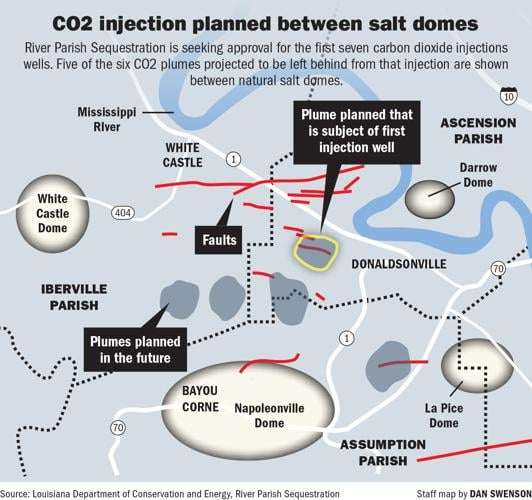
The network of wells, pipelines and at least five future underground CO2 plumes would seek to avoid homes and slip in among underground obstructions like salt domes, natural faults above and below the future plumes but not through them, and decades of oil and gas drilling, plans show.
The first of the seven planned wells, which would generate one of the plumes, is under review. It would be only the second Class VI carbon injection well in ¶¶Òõh since the U.S. Environmental Protection Agency granted the state authority over the regulatory process in early 2024.
The well would inject up to 2.2 million tons of CO2 per year under the Bruly McCall area near La. 943, starting in 2027, plans say.
Though carbon dioxide exists in the atmosphere and is exhaled by people, the industrial capture and storage process involves compressing it to a near liquid state for transport by pipeline and injection. That means leaks from delivery lines, as has happened in Mississippi and Sulphur, can release highly concentrated clouds that can act as asphyxiants and starve oxygen from fossil fuel-burning cars and trucks.
Experts discount the possibly as very remote, however, that CO2 in such high concentrations could leak from deep underground storage and reach the surface. Such storage has raised concerns from critics about slower leaks into drinking water aquifers, however.
Blue Sky officials and others supporting the technology countered carbon capture is highly regulated and has a close parallel that’s been safely in practice for a half century: using C02 injections to enhance oil recovery.
For River Parish Sequestration, its first injection zone will be sealed by a rock overlay that is thicker than the height of the ¶¶Òõh State Capitol, the company says. The plume, which would exist in several layers from nearly 4,900 feet and nearly 10,000 feet deep, would sit more than a half-mile below the lowest fresh water aquifer, company plans say.
The injection would work at the bottom of the storage zone and ascend, going into increasingly shallow layers of sedimentary rock. Eighty years after injection starts and 50 years after it has ended, the storage zone is projected to extend horizontally in an almost two-square-mile oval deep underneath the Bruly McCall area, company modeling shows.
Michael Manteris, co-president of Blue Sky, said that his company spent more than five years lining up voluntary agreements with over 80 landowners for access to the storage areas under some 30,000 acres.
He said the company’s magnetic and seismic testing, an exploratory well and other work show that the western Ascension piece of the farmland is away from homes, active drinking water wells and orphan wells that could provide a path for stored CO2 to escape.
Residents at the hearing were not convinced, saying they want growth but also to live safely.
“(Carbon capture) will not work. It has not worked, and we just don’t want the experiment to happen with us,â€� said Ashley Gaignard, a Donaldsonville resident who leads the advocacy group Rural Roots ¶¶Òõh.
'Poverty into prosperity'
Manteris said the company will have a monitoring program to track the underground plume. Emergency response plans will also be in place for leaks from storage sites or pipelines.
The project received mixed support from local officials.
James LeBlanc, the St. Amant fire chief and a parish executive, delivered letters of backing from Parish President Clint Cointment and Sheriff Bobby Webre. LeBlanc told state officials the well is part of the parish’s effort to reduce poverty on the west bank.
“This industry is about quality of life on the west bank. It’s about overall enhancement of the west bank, and it’s about turning poverty into prosperity,� LeBlanc said.
But two west bank officials, Parish Councilman Oliver Joseph and School Board member Robyn Penn Delaney, voiced their opposition. Delaney said the well and other infrastructure would be too close to Lowery elementary and middle schools, potentially exposing children to a CO2 leak — about 2 miles away.
Some residents suggested parish officials’ support could result in tough elections for them. Others objected to east bank officials supporting CO2 storage that would affect only the other side of the river.
“Put it wherever they’re at … Bring it over there,� said Louis Boudreaux, 88, of Donaldsonville.
Federal 45Q tax credits offer up to $93 per ton to the companies capturing their CO2 emissions. As the storage company, River Parish Sequestration doesn’t receive those credits, company officials said, but will be paid by plants that get them.
In September 2024, the U.S. Department of Energy awarded River Parish Sequestration a $32.2 million grant. The company matched that with $8.1 million, a .
Blue Sky Infrastructure, the parent of River Parish Sequestration, is managed by the more than $1 trillion private equity fund Blackstone.